
Red Palm Weevil Treatment
Understanding the problem and taking targeted action
Red Palm Weevil in Palm Trees
The Red Palm Weevil (Rhynchophorus ferrugineus) is a wood-boring insect that in recent years has caused severe damage to palm tree populations across many Mediterranean areas, including Sardinia.
Originally native to Southeast Asia, this beetle was accidentally introduced into Europe, where it found favorable conditions for rapid spread in the Mediterranean climate.
Ornamental and fruit-bearing palms are a key element of urban and coastal landscapes. The presence of the red palm weevil makes careful management essential, based on monitoring, prevention, and targeted technical interventions, avoiding improvised or delayed actions.
What is the red palm weevil and how it affects palm trees
The red palm weevil is a beetle ranging in size from 3 to 5 centimeters, recognizable by its reddish-brown coloration.
The most severe damage is not caused by the adult insect, but by the larvae that develop inside the palm.
Females lay their eggs near the bases of fronds or in cracks and wounds along the trunk. Once hatched, the larvae bore deep tunnels within the internal tissues, feeding on the plant’s vital fibers. This process progressively compromises the structural and transport tissues, weakening the palm from the inside.
The biological cycle can be completed in just a few months, and without control measures, multiple generations may overlap throughout the year.
Why infestations are difficult to detect
One of the most critical aspects of red palm weevil infestations is the difficulty of early detection.
For a long period, the palm may appear externally healthy, while significant internal damage is already underway.
When visible symptoms finally emerge, the infestation is often at an advanced stage. This makes a preventive approach and regular technical inspections essential, especially in settings where palms have ornamental or historical value.
Signs and symptoms to watch for
Some indicators may suggest the presence of red palm weevil infestation:
- broken or collapsed central leaves
- abnormal dropping of fronds from the crown
- asymmetric or unbalanced canopy
- presence of fibrous material or frass at the base of the palm
- unusual odors caused by tissue decomposition
These symptoms should never be underestimated and always require professional assessment, as they can be mistaken for water stress or mechanical damage.
Structural damage and long-term consequences
Red palm weevil larvae excavate galleries that compromise both the mechanical stability and physiological functions of the palm.
When damage reaches the apical meristem, the plant’s ability to produce new leaves is impaired, leading to a progressive loss of vitality.
At this stage, recovery becomes difficult and, in some cases, impossible.
For this reason, acting before visible symptoms appear is the only truly effective strategy.
The importance of prevention
In managing red palm weevil infestations, prevention is the key factor.
A structured program of monitoring and regular interventions helps to:
- reduce the risk of infestation
- contain early-stage attacks
- preserve palm health over time
Relying on occasional checks or intervening only when damage is clearly visible exposes the palm to a high risk of irreversible loss.




Endotherapy: a targeted and sustainable approach
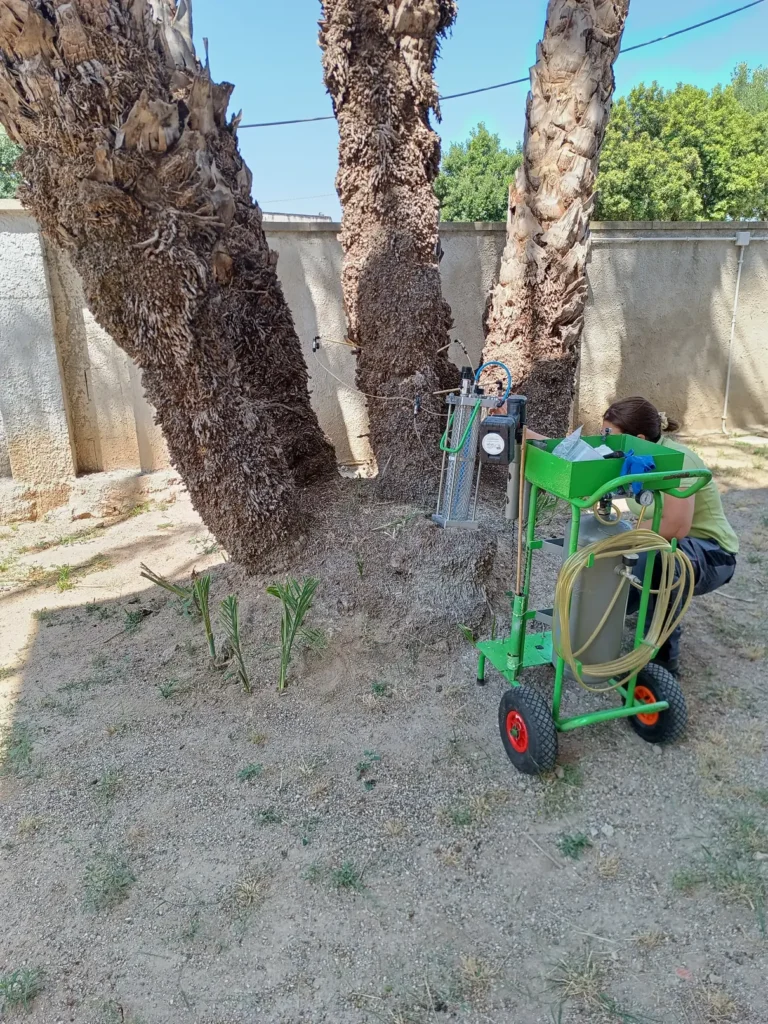
Among the most effective techniques for red palm weevil treatment, endotherapy represents a well-established technical solution.
This method allows the treatment to be delivered directly into the palm’s vascular system, enabling the active ingredients to be distributed evenly throughout the plant.
Endotherapy offers several advantages:
- targeted action within the plant
- reduced environmental impact
- no dispersion into the air or surrounding soil
- long-lasting effectiveness
Each treatment is assessed and scheduled based on the palm’s condition, the season, and the level of risk.
Local experience and proven results
Since 2017, GardenStyle has been actively involved in protecting palm trees through consistent and professionally executed endotherapy treatments.
Over the years, numerous palms across Sardinia—including Costa Smeralda, Villasimius, Alghero, and Sassari—have been stabilized and recovered, even in cases of early-stage infestation.
Field experience has shown that a technical, consistent, and well-planned approach delivers concrete and long-lasting results, significantly reducing palm tree loss.
Conclusion
The red palm weevil represents a complex challenge that requires knowledge, attention, and appropriate interventions.
Effective management is not based on improvised solutions, but on prevention, monitoring, and targeted treatments such as endotherapy.
A professional assessment makes it possible to define the most suitable strategy for each palm, with the goal of preserving its health and long-term value.